
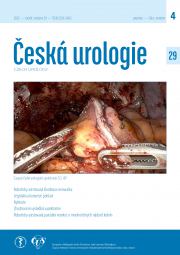
Ces Urol X:X | DOI: 10.48095/cccu2026001
Robot-assisted simple prostatectomy – an alternative to transvesical prostatectomy for significantly enlarged prostate
- Urologická klinika LF UK a FN Hradec Králové
Introduction: We present an innovative procedure for the surgical treatment of a significantly enlarged prostate causing urinary retention. The very good long-term results of transvesical prostatectomy led us to search for a less invasive surgical alternative. Robot- -assisted simple prostatectomy for benign prostatic hyperplasia is increasingly promoted in many countries with advanced healthcare systems. The clear surgical procedure and significantly shortened postoperative recovery led us to adopt this method. We present the performance of robotic enucleation on the da Vinci Xi - multiport device, which we adopted from abroad.
Case report: A 61-year-old man, with excellent performance status, without serious comorbidities, had a significantly enlarged prostate measuring 7 × 6 × 5.5 cm with endovesical prominence and had refractory urinary retention, despite the administered combination pharmacotherapy at maximum dose. A magnetic resonance imaging was performed before the operation, which demonstrated enlarged benign prostatic hyperplasia without suspicion of prostate cancer. Similarly, the rectal examination and repeated prostatic specific antigen collection were without suspicion of the presence of carcinoma. The patient was offered robot-assisted enucleation of the enlarged prostate, which he agreed to. The operation was performed with the da Vinci Xi multiport robotic operating system. The ports were placed above the umbilicus similarly to radical prostatectomy. The patient was in the Trendelenburg position and the surgical approach was intraperitoneal. The bladder was opened at the apex with a longitudinal incision and temporary fixation sutures were placed on the edges of the incision for sufficient access for robotic instruments and a camera. The ureteral orifices, which are often close to the enlarged prostate, were localized and then enucleation was initiated. First, the entire layer of the bladder mucosa is cut with scissors and then the whitish hyperplasia of the prostate is enucleated from the surgical capsule. Bleeding is promptly stopped by coagulation. In some operations, it is possible to remove the entire enlarged prostate at once, sometimes removal in lobes is necessary. The next step is to pull the mucosa over the enucleation site and fix it with a continuous suture. It is appropriate to use a barbed suture (for example, V-Loc or similar). Finally, a catheter is inserted and left in place for 5-7 days. From June 2024 to September 2026, 24 operations have been performed. The median duration of the operation was 145 (90-220) minutes and the estimated blood loss was 220 (100-800) mL. The median weight of enucleated prostate was 89 (57-142) g. We did not experience any serious perioperative or early complications. In three patients, a temporary indwelling catheter was required due to high post-void residual. After repeated catheter removal, urinary retention recurred in only one patient. In three patients, a bladder diverticulum was also resected together with the enucleation of the benign prostatic hyperplasia.
Conclusion: Robotic enucleation is a suitable alternative to open surgery for a severely enlarged prostate, especially with a large middle lobe. The disadvantage is the higher cost of the operation. The advantages are enucleation under visual control, the possibility of rapid coagulation and covering the site with healthy mucosa, which leads to a decrease inurinary urgency. Other positives are lower blood loss, no need for Intensive Care Unit in the postoperative course, shorter hospitalization and easier nursing care for medical personnel.
Keywords: benign prostatic hyperplasia – robotic simple prostatectomy – prostate enucleation
Received: November 26, 2025; Revised: January 2, 2026; Accepted: January 5, 2026; Prepublished online: January 29, 2026
video

References
- Shah AA, Gahan JC, Sorokin I. Comparison of robot-assisted versus open simple prostatectomy for benign prostatic hyperplasia. Curr Urol Rep 2018; 19(9): 71. doi: 10.1007/s11934-018-0820-1.
 Go to original source...
  Go to PubMed...
 - Morozov A, Bogatova S, Bezrukov E et al. A systematic review of robot-assisted simple prostatectomy outcomes by prostate volume. World J Urol 2024; 42(1): 565. doi: 10.1007/s00345-024-05264-y. Go to original source... Go to PubMed...
- Khalil MI, Chase A, Joseph JV et al. Standard multiport vs single-port robot-assisted simple prostatectomy: a single-center initial experience. J Endourol 2022; 36(8): 1057-1062. doi: 10.1089/end.2021.0510. Go to original source... Go to PubMed...