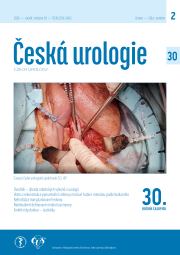

Czech urology - Ahead of Print
Verification of renal ischemia during selective clamping of the renal artery branch during robot assisted resection of a renal tumor using ICG and NIR imaging – video
Milan Hora, Adriana Bartoš Veselá, Ivan Trávníček, Petr Stránský jr., Dominika Šiková, Jitka Voráčková, Tomáš Ürge, Jiří Ferda, Jan Pernický, Marián Švajdler, Kristýna Pivovarčíková
Ces Urol X:X 
Objective: Verification of renal ischemia during renal artery clamping in minimally invasive renal tumor resection is possible based on the appearance of the kidney, using Doppler ultrasonography and indocyanine green (ICG) administration with narrow light spectrum application (NIR (near infrared) imaging/fluorescence). In most cases, the first two methods are sufficient; we use ICG very sparingly, only when selecting clamping of multiple arteries or branches of the renal artery. The video shows the use of ICG in robotic resection (RR) of a kidney tumor with a duplex renal artery. Abstract: ICG with NIR imaging technology has been available since July...
Robot-assisted simple prostatectomy – an alternative to transvesical prostatectomy for significantly enlarged prostate
Miloš Broďák, Petra Koňaříková, Václav Krejčí
Ces Urol X:X | DOI: 10.48095/cccu2026001 
Introduction: We present an innovative procedure for the surgical treatment of a significantly enlarged prostate causing urinary retention. The very good long-term results of transvesical prostatectomy led us to search for a less invasive surgical alternative. Robot- -assisted simple prostatectomy for benign prostatic hyperplasia is increasingly promoted in many countries with advanced healthcare systems. The clear surgical procedure and significantly shortened postoperative recovery led us to adopt this method. We present the performance of robotic enucleation on the da Vinci Xi - multiport device, which we adopted from abroad. Case report: A 61-year-old...
Retrospective single centre study of microwave ablation in the treatment of cT1 renal cell carcinomas
Jan Hnátek, Jakub Horňák, Martin Mašek, Jan Hrbáček
Ces Urol X:X | DOI: 10.48095/cccu2026002 
Major statement: Microwave ablation is a miniinvasive method of cT1 renal cell carcinomas treatment. The aim of the study is to present the oncological results and the occurrence of postoperative complications of this method at our institution. Summary: Aim: Microwave ablation is an alternative to partial nephrectomy in the treatment of cT1 renal carcinomas. This retrospective study aims to evaluate the oncological results and postoperative complications of this method. Patient population: The retrospective, single institution study included 63 patients who underwent a total of 78 microwave ablations at our institution, between 2012 and 2023. Results:...
Robot-assisted transvesical prostatectomy – video
Martin Fila, Miroslav Záleský, Jiří Heráček
Ces Urol X:X | DOI: 10.48095/cccu2026003 
Introduction: Benign prostatic hyperplasia (BPH) is a common cause of lower urinary tract symptoms. When conservative treatment fails, surgical management is indicated. Robot-assisted transvesical prostatectomy represents a minimally invasive alternative to open surgery. At our department, patients with large adenomas (> 100 mL) are indicated for either HoLEP or robot-assisted transvesical prostatectomy. The procedure is performed using a multi-port system, although recent publications suggest that a single-port approach may represent a promising alternative. A potential advantage of this procedure compared to HoLEP is the avoidance of transurethral...
Combination of systemic and surgical treatment in a patient with primarily inoperable renal cell carcinoma in a horseshoe kidney: the importance of multidisciplinary collaboration – updated results of 3-year follow-up
Jiří Herman, Vladimír Študent jr., Aleš Vidlář, Anežka Zemánková, Igor Hartmann
Ces Urol X:X | DOI: 10.48095/cccu2026004 
Primarily inoperable, locally advanced renal cell carcinoma represents a significant challenge in uro-oncology. Although systemic therapy is not a standard component of treatment in this setting, in carefully selected patients it may lead to disease regression and enable subsequent surgical resection. We present updated results of a 3-year follow-up of a patient with an initially inoperable finding in whom systemic therapy created the conditions for a subsequent successful surgical intervention.
Robot-assisted nephroureterectomy (RA-NUE) – video
Milan Hora, Tomáš Ürge, Adriena Bartoš Veselá, Petr Stránský jr., Dominika Šiková, Tomáš Pitra, Hana Sedláčková, Petr Stránský, Ivan Trávníček, Blanka Drápelová, Jitka Voráčková, Jiří Ferda, Jan Pernický, Kristýna Pivovarčíková, Ondřej Fiala
Ces Urol X:X | DOI: 10.48095/cccu2026005 
Introduction: The indications for nephroureterectomy (NUE) for upper tract urothelial carcinoma (UTUC) are relatively clear, but questions remain regarding the technique used to perform NUE and the indications for lymphadenectomy (LND – lymph node dissection) during NUE. There is a wide range of NUE techniques (open surgery, laparoscopy, endoscopy). Basically, there is a nephrectomy phase and an ureterectomy phase, and possibly also LND, with individual techniques being combined. Open NUE remains the dominant technique for advanced tumors, otherwise minimally invasive techniques are widely used. After many years of gradually performing three...

